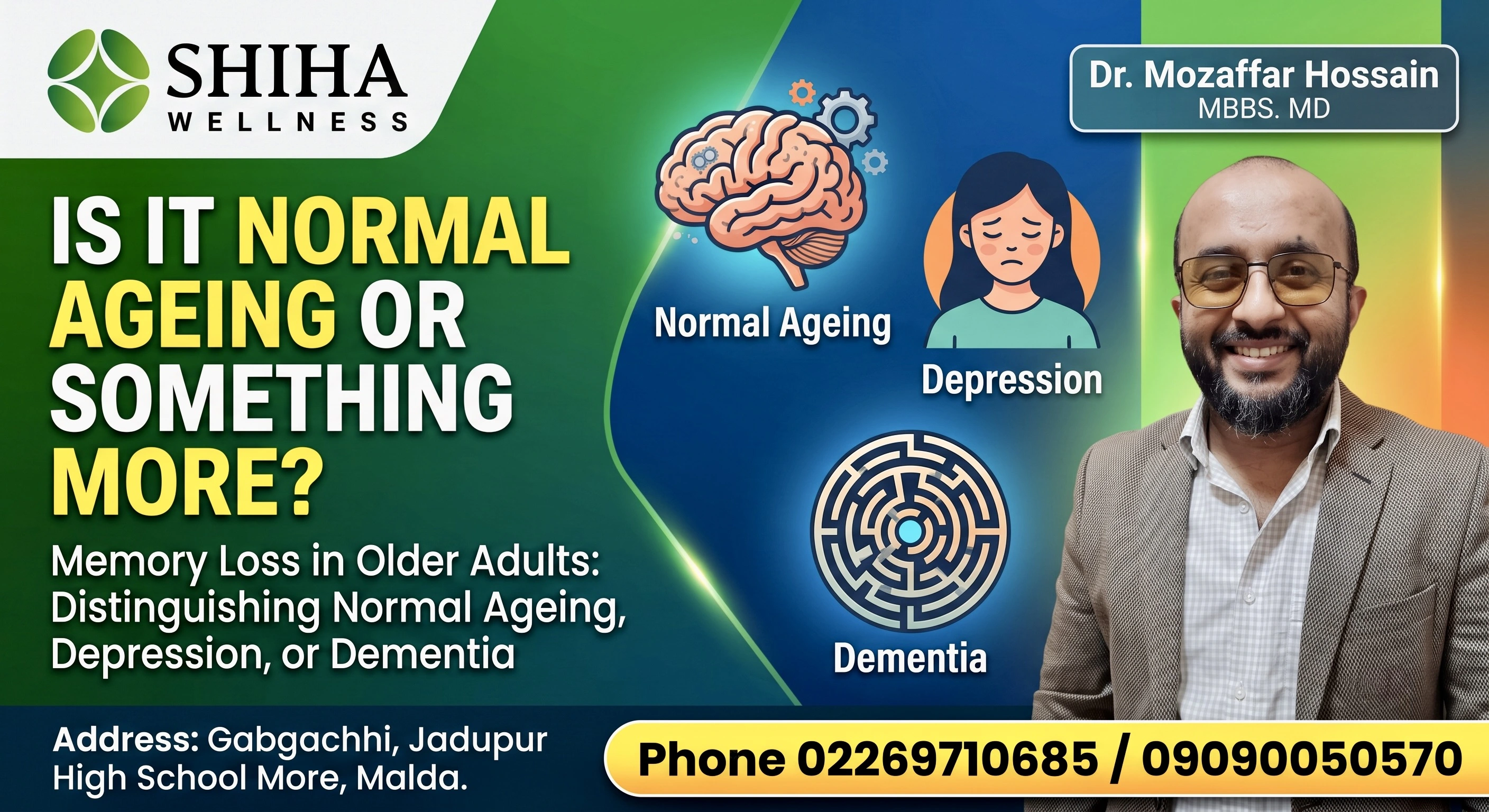
Memory Loss in Older Adults: Normal Ageing, Depression or Dementia?
"Baba keeps asking the same question again and again." "Maa forgot the way back from the market." "Dadu is not like before." Many families in Malda notice these changes, but are not sure what they mean. Is it just age? Is it sadness? Or is it dementia? The honest answer is: it can be any of these, and sometimes more than one at the same time. What matters is not to ignore it, and to get a proper assessment early.
Is Forgetting Things Normal as We Get Older?
Yes, to a degree. As we age, the brain may take a little longer to recall information. This is called normal age-related forgetfulness. Typical examples include:
- Misplacing glasses or keys, then finding them by retracing steps
- Forgetting a name, but remembering it later
- Occasionally missing an appointment, but remembering when reminded
- Taking a little longer to learn something new, such as a mobile phone feature
In normal ageing, the person remains independent, can manage money, medicines and travel, and usually notices and worries about their own forgetfulness.
Memory Loss Caused by Depression
Depression is common in older adults, and it is often missed. Many elderly people do not say "I feel sad". Instead, they say "I can't concentrate", "my mind is blank", "I am forgetting everything", or complain of body aches, poor sleep and loss of appetite.
Clues that depression may be involved:
- Low mood, tearfulness or irritability for weeks
- Loss of interest in prayer, TV, family gatherings or hobbies
- Poor sleep or sleeping too much, reduced appetite
- Feeling worthless, hopeless or a burden to the family
- Slowed speech and movement, and answers like "I don't know" when asked a question
The encouraging news is that memory and concentration often improve when depression is properly treated. However, depression can also be an early sign of dementia, so a careful assessment is important rather than assuming one or the other. If a person ever talks about not wanting to live, please do not delay: seek medical help immediately.
Dementia and Alzheimer's Disease: What Are the Warning Signs?
Dementia is not one disease. It is a group of conditions in which memory, thinking and behaviour gradually worsen to the point where daily life is affected. Alzheimer's disease is the most common cause. Others include vascular dementia (linked to strokes and blood-vessel damage), Lewy body dementia and frontotemporal dementia.
Warning signs families should not ignore:
- Repeating questions or stories within minutes, and forgetting recent conversations
- Getting lost in familiar places, such as the neighbourhood or the way home
- Difficulty with everyday tasks: cooking, handling money, using the phone, or taking medicines correctly
- Confusion about time, place or people: not knowing the day, or not recognising relatives
- Trouble finding words or following conversations
- Misplacing things in odd places and accusing others of taking them
- Poor judgement: falling for scams, leaving the gas on, dressing unsuitably for the weather
- Personality or behaviour change: unusual anger, suspicion, withdrawal, restlessness, or night-time wandering
- Hallucinations or fixed false beliefs, for example believing someone is stealing from them
Normal Ageing vs Depression vs Dementia: A Quick Comparison
| Feature | Normal ageing | Depression | Dementia |
|---|---|---|---|
| Onset | Very gradual | Often over weeks to months, may follow a loss or stress | Gradual and usually progressive over months to years |
| Awareness | Person notices and may worry | Person often complains a lot about memory | Person may minimise or be unaware; family notices more |
| Mood | Normal | Low, hopeless, loss of interest | Variable; may be anxious, irritable or apathetic |
| Daily activities | Independent | May be reduced from lack of energy | Increasingly difficult |
| Recent memory | Minor lapses, recalled later | Poor effort and attention, "I don't know" | Clear difficulty forming and recalling new memories |
| Outlook | Stable | Often improves with treatment | Progressive, but symptoms can be managed and support planned |
This table is a guide, not a diagnosis. In real life the picture is often mixed, which is why a clinical assessment matters.
Other Treatable Causes of Memory Problems
Before concluding that a person has dementia, doctors look for conditions that can cause or worsen memory loss. Many are treatable, and treating them can bring real improvement:
- Vitamin B12 deficiency, which is common, including in vegetarians
- Thyroid problems, anaemia, uncontrolled diabetes, kidney or liver problems
- High blood pressure and previous small strokes
- Poor sleep or untreated sleep problems
- Side effects of some medicines, including certain sleeping tablets and sedatives
- Alcohol use
- Hearing or vision loss, which can make a person seem confused
- Infections (such as urinary infection) causing sudden confusion in the elderly
- Less common brain conditions such as a head injury with bleeding or fluid build-up
When Should You See a Dementia Doctor in Malda?
Consider booking an assessment if you notice any of the following:
- Forgetfulness is getting worse over several months
- The person is repeating questions, getting lost or struggling with money, medicines or cooking
- There are changes in mood, sleep, personality or behaviour
- The family is worried, even if the person says "I am fine"
- You are unsure whether it is age, depression or something else
You do not need to wait until the problem is severe. Early assessment helps to find treatable causes, start the right treatment, and allow the family to plan care and safety.
What Happens in a Memory Assessment?
A memory or Alzheimer's assessment at a neuropsychiatry clinic is a calm, step-by-step process. It usually includes:
- A detailed history from the patient and from a family member who knows them well. The family's observations are very valuable.
- Review of medicines and past medical problems such as diabetes, blood pressure, strokes or head injury
- Memory and thinking tests using standard screening tools to check attention, memory, language and problem-solving
- Mood and sleep assessment to look for depression, anxiety or other psychiatric causes
- Physical and neurological examination
- Investigations when needed, such as blood tests (for example vitamin B12 and thyroid) and brain imaging like CT or MRI, advised according to each person's situation
After assessment, the doctor explains the likely cause in simple language, and discusses a treatment and support plan with the patient and family.
Treatment and Support for Memory Loss
Treatment depends on the cause:
- Treating reversible causes, such as vitamin deficiency, thyroid problems or medicine side effects
- Treating depression, anxiety and sleep problems, which can improve thinking, mood and quality of life
- Medicines for dementia: in Alzheimer's disease and some other dementias, certain medicines may help to ease symptoms or slow their worsening for some time in some people. They do not cure the disease, and the doctor decides whether they are suitable.
- Managing behaviour symptoms such as agitation, suspicion or night-time restlessness, with non-drug approaches first and medicines only when needed
- Controlling heart and blood-vessel risks: blood pressure, diabetes, cholesterol, and avoiding smoking and excess alcohol
- Daily routine and activity: regular walking, sleep, social contact, prayer or hobbies, and mentally engaging activities
- Hearing and vision correction, which supports memory and safety
How Families Can Help at Home
- Keep a simple, fixed daily routine for meals, medicines, walks and sleep
- Use a large calendar, clock and a medicine box to reduce confusion
- Keep important things in the same place, and make the home safe: good lighting, no slippery floors, gas and stove safety
- Speak slowly and calmly, one instruction at a time. Avoid arguing or correcting repeatedly.
- Encourage conversation, old photographs, music and gentle activity
- Do not leave a person who gets lost or confused to go out alone
- Look after the caregiver too. Caring for a person with dementia is tiring, and caregivers need rest and support.
Common Myths About Memory Loss
- "It's just old age, nothing can be done." Not always. Some causes are treatable, and even when dementia is present, support and treatment can improve comfort and safety.
- "Only mad people go to a psychiatrist." A psychiatrist or neuropsychiatrist is a doctor who treats the brain and mind, including memory, mood, sleep and behaviour problems. Seeking help is a sign of care.
- "If we don't talk about it, it will go away." Waiting can delay treatment of reversible causes and make planning harder.
ভুলে যাওয়ার চিকিৎসা: সংক্ষেপে বাংলায়
বয়স বাড়লে একটু-আধটু ভুলে যাওয়া স্বাভাবিক। কিন্তু একই প্রশ্ন বারবার করা, চেনা রাস্তায় পথ হারানো, টাকাপয়সা বা ওষুধ সামলাতে অসুবিধা হওয়া, মেজাজ বা আচরণে পরিবর্তন, রাতে ঘুমের সমস্যা, কিংবা সন্দেহপ্রবণতা বেড়ে যাওয়া অবহেলা করা ঠিক নয়। সব ভুলে যাওয়াই ডিমেনশিয়া বা আলঝাইমার্স নয়। অনেক সময় বিষণ্ণতা, ভিটামিন বি১২-এর অভাব, থাইরয়েডের সমস্যা, ঘুমের অভাব বা কিছু ওষুধের পার্শ্বপ্রতিক্রিয়াও কারণ হতে পারে, যার চিকিৎসা সম্ভব।
তাই বাড়ির কারও স্মৃতিশক্তি নিয়ে চিন্তা হলে দেরি না করে একজন মানসিক রোগ বিশেষজ্ঞ বা নিউরোসাইকিয়াট্রিস্টকে দেখান। আগে ধরা পড়লে কারণ বোঝা, সঠিক চিকিৎসা শুরু করা এবং পরিবারের প্রস্তুতি নেওয়া সহজ হয়। হঠাৎ অজ্ঞান-ভাব, কথা জড়িয়ে যাওয়া, শরীরের একদিকে দুর্বলতা, মাথায় আঘাত বা তীব্র জ্বরের সঙ্গে বিভ্রান্তি দেখা দিলে অবিলম্বে হাসপাতালের জরুরি বিভাগে যান।
Frequently Asked Questions
Is forgetfulness a normal part of ageing?
Mild forgetfulness is common. But memory problems that affect daily life, such as repeated questions, getting lost, or difficulty managing money or medicines, should be assessed by a doctor.
Can depression cause memory loss in older people?
Yes. Depression can reduce attention and concentration and make a person appear very forgetful. Memory often improves with treatment, but depression can also be an early sign of dementia, so proper assessment is important.
Is every memory problem dementia or Alzheimer's?
No. Vitamin B12 deficiency, thyroid problems, depression, poor sleep, infections and medicine side effects can all cause memory problems, and several are treatable.
Can dementia be cured?
Most common dementias, including Alzheimer's disease, cannot be cured at present. But symptoms can be managed, treatable contributors can be corrected, and families can be supported so that the person stays as comfortable, safe and independent as possible.
Where can I get an Alzheimer's assessment in Malda?
SHIHA Wellness, Gabgachhi, Jadupur High School More, Malda, offers neuropsychiatric assessment for memory problems. The clinic is open every day from 9 am to 5 pm.
Should a family member come along to the appointment?
Yes, if possible. A family member's account of day-to-day changes is very helpful. Please also bring all current medicines and any previous reports.
Worried About a Parent's or Grandparent's Memory?
Meet Dr Mozaffar Hossain MD at SHIHA Wellness for a careful, respectful assessment of memory loss, depression and dementia in Malda. Please bring a family member who knows the person well, along with all medicines and past reports.
Address: Gabgachhi, Jadupur High School More, Malda 732103
Open: Every day, 9 am to 5 pm
Phone / WhatsApp: 9090050570 · 02269710685
Medical disclaimer: This article is for general awareness and does not replace a personal medical consultation. Symptoms, tests and treatment differ from person to person. Please consult a qualified doctor for diagnosis and advice. In an emergency, go to the nearest hospital immediately.